
Slice Master : Idle Clicker
Oreon StudiosSimulation
4.61.06K Reviews
- Version
- 1.0.4
- Installs
- 10.00M
- Age Rating
- Everyone
Screenshots

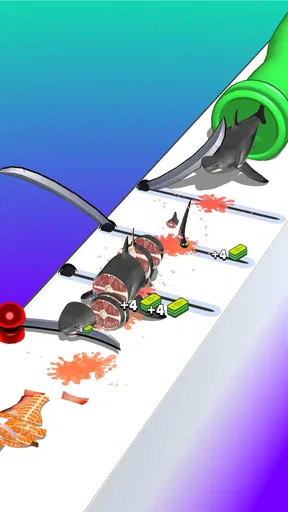

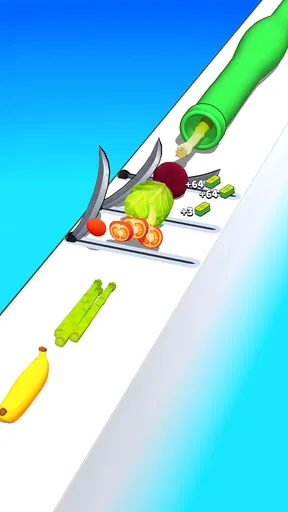




Our Review of Slice Master : Idle Clicker
 Analysis by Appyee
I spent time with Slice Master: Idle Clicker as a light simulation game built around one clear idea: improve your cutting skill, then use that skill to slice fresh fish with better precision. It is free to start, rated for Everyone, and made by Oreon Studios. The concept is easy to understand within moments, but the real question is whether the simple loop stays satisfying after the first few sessions.
My short answer is that it works best as a low-pressure game for brief breaks. It does not ask you to learn a complicated control scheme or follow a large story. Instead, it focuses on repetition, timing, and the small pleasure of seeing a task become cleaner as you improve. That makes it approachable, although players looking for a deep management game, a competitive challenge, or a long-form adventure may find the experience too narrow.
How the slicing loop feels in everyday play
The game belongs to the simulation category, but it presents that idea in a very accessible way. Rather than overwhelming me with menus or technical instructions, it puts the act of slicing at the center. The appeal comes from trying to make each action feel more controlled, then continuing the cycle as progress builds.
I found that simplicity useful when I wanted something I could open without preparing for a long session. A realistic example would be playing while waiting for an appointment or taking a short break from work. The game suits that moment because its central activity is immediately readable. I do not need to remember a complicated plot or reconstruct a large strategy from a previous session.
That same simplicity is also the main limitation. The experience depends heavily on whether you enjoy repeating a focused action. If you need several different activities, character development, exploration, or a strong sense of narrative discovery, this is probably not the right simulation game for you. Its identity comes from narrowing the experience down rather than expanding it.
The store summary describes sharpening skills and slicing fish with precision, and that is a fair description of the intended mood. I would not approach it expecting a detailed cooking simulator. The pleasure is closer to practicing a compact task and watching the result become more efficient. That distinction matters because the game is easier to appreciate when judged as a casual precision loop, not as a full culinary sandbox.
Progress feels best when I treat it as a short-session game
The most useful way I found to play was to set a small personal goal before starting. Instead of opening the game with the expectation of a major achievement, I would focus on improving the next few actions or simply making a little progress before putting the phone away. This keeps the repetition from feeling like an obligation.
There is a subtle trade-off here. A short, focused loop can be relaxing because it removes decision fatigue, but it can also make progress feel less meaningful if you prefer constant novelty. I recommend it more readily to someone who enjoys incremental games than to someone who wants every session to introduce a new mechanic.
One non-obvious advantage is that the narrow task makes it easy to notice your own habits. I became more aware of rushing, tapping without purpose, or continuing after the session had stopped feeling enjoyable. That makes the game useful as a small concentration exercise, even though I would not describe it as a serious skill-training tool. The benefit comes from paying attention to the action, not from any promise of real-world improvement.
Players who dislike idle-style pacing should think carefully before installing it. The title itself signals that the game is designed around gradual progress, so it is not aimed at people who want every reward to come from a demanding challenge. If you prefer direct control over every part of advancement, a more traditional action or cooking game may feel more rewarding.
Spending is visible, but the value depends on your patience
The game is free to download and play, with optional in-app purchases ranging from $0.49 to $29.99 per item. That range is important: the entry point is small, but the upper end is a much more meaningful commitment. I would therefore treat purchases as a convenience decision rather than something to add automatically during the first session.
My practical advice is to play long enough to understand whether the basic loop holds your attention before spending anything. If the slicing routine already feels repetitive without assistance, paying will not change the underlying fact that the game is built around repetition. On the other hand, if you enjoy the loop and simply want to support the developer or make progress more convenient, the purchase structure gives you that option.
I would also avoid making a purchase while chasing a temporary feeling of being behind. Idle games can create pressure by showing progress that continues beyond the moment you stop playing, and that can make a paid shortcut feel more urgent than it really is. In this case, the fairest approach is to decide in advance whether you are comfortable spending and what kind of value you expect from it.
The available purchase range tells me that spending can be modest or substantial, but it does not by itself prove that the game is unfair. I cannot responsibly claim that purchases are required, that they dominate the experience, or that they provide a particular advantage without confirmed details about how each item works. What I can say is that a free starting point makes it sensible to test the core loop first, while the highest listed item price deserves deliberate consideration rather than an impulse tap.
Fairness matters even in a quiet single-player loop
Competitive fairness is slightly different here from what I would expect in a multiplayer action game. The main concern is not whether another player can defeat me in a match. It is whether progress feels satisfying when I choose not to spend. For a casual simulation game, that distinction is important: a relaxed experience can still feel unpleasant if it constantly turns ordinary progress into a sales prompt.
I would judge the game fairly by asking three questions during use. Can I enjoy the basic slicing action without paying? Does progress still feel understandable when I ignore purchases? And do I feel invited to play, rather than pushed to buy? Those questions are more useful than assuming either that every free game is generous or that every in-app purchase system is exploitative.
At this point, the confirmed purchase information establishes the price range, but not the exact effects or frequency of offers. I therefore would not label the game pay-to-win, especially because the central experience is not presented as a competitive battle. I also would not promise that every player will find the monetization comfortable. The honest position is to try the free portion with a spending limit and decide based on how the prompts affect your enjoyment.
A good personal rule is to separate progress goals from spending goals. If I want to improve my slicing routine, I should first see what patience and practice provide. If I later decide that a purchase is worth it, that should be because I value the convenience, not because I feel forced to catch up with an invisible rival. This approach keeps the game in its proper place as casual entertainment.
What the current release tells me about compatibility
The game was released on July 17, 2024, and the current version is 1.0.4. It requires Android 7.0 or later, which makes it accessible to people using a wide range of Android devices. Before downloading, I would still check that the phone meets that operating-system requirement, particularly if it is an older device that has not received recent updates.
Those version details are useful, but they should not be confused with a guarantee about how the game will feel on every phone. Screen size, touch response, and general device condition can affect any game built around precise interaction. If your phone has an unreliable touch screen, a precision-focused title may be frustrating even when the software itself is working normally.
I also see the current version as a reason to keep expectations measured. A version number can change over time, and an update may alter balance or presentation. I would make a habit of checking the version shown on the download page before installing, especially if I am returning after a long break. That is a more reliable habit than assuming my previous experience will remain identical.
The age rating of Everyone makes the game broadly suitable from a content perspective. That does not mean every child will enjoy the repetitive structure, nor does it remove the need for an adult to guide spending on a shared device. The rating answers one question about audience suitability, while patience and purchase habits answer another.
Where it stands beside other casual simulation choices
Compared with a conventional cooking simulator, this game appears more focused and less demanding. A larger cooking game usually asks me to manage several ingredients, tools, recipes, or customer expectations. Slice Master: Idle Clicker instead makes the cutting action itself the attraction. That is an advantage when I want a clean, uncluttered activity, but a weakness when I want a broader sense of running a kitchen.
Compared with a standard idle game, the slicing theme gives the progression a more tangible identity. I am not simply watching abstract numbers rise; the central fantasy is tied to becoming more precise with a specific task. Still, players who enjoy deep resource planning may find the experience lighter than their usual choice. The game is better suited to a quick rhythm than to a spreadsheet-style optimization session.
It also differs from competitive skill games because its value does not depend on defeating another person. That can make it more comfortable for players who dislike rankings or stressful matches. The trade-off is that there may be less external motivation for someone who needs opponents, leaderboards, or a clear win condition to stay engaged.
My recommendation changes depending on what you want from a phone game. Choose this one if you like compact loops, incremental progress, and a fish-slicing theme that can be understood immediately. Choose a fuller simulation if you want layered systems and long-term planning. Choose an action game if you want reflex pressure and variety. The comparison is not about which style is universally better; it is about matching the game to the kind of attention you have available.
Small techniques that make the experience more comfortable
My first practical tip is to use short sessions as a filter. Play until the loop either feels naturally satisfying or clearly repetitive, then stop. Do not assume that a longer session will reveal a completely different game if the basic action already fails to hold your attention. This is especially important for free games, because the absence of an upfront price can make it easy to keep playing simply because it is available.
Second, pay attention to whether precision improves when you slow down. In a game built around cutting accurately, rushing may feel active but may not produce the most satisfying results. I found it more useful to treat each action as a small timing decision rather than tapping as quickly as possible. This is a simple adjustment, but it changes the mood from button pressing to controlled practice.
Third, decide how you will handle purchases before the game presents them. A spending limit is more effective when chosen calmly, away from a moment of frustration. Because individual items can reach $29.99, I would not leave the decision entirely to impulse. If you are setting the game up for a child, I would be particularly careful with account and device purchase controls.
Fourth, use the game as a transition activity rather than a task that must fill an entire evening. It works well between larger activities because the theme and controls are easy to return to. When I wanted a relaxing pause, that was a strength. When I wanted a game to occupy me for hours with fresh discoveries, the same design felt restrictive.
Questions I would consider before installing
If you are wondering whether it is genuinely free to try, yes: the game is listed as free, while optional items are available inside it. That means you can evaluate the central experience before deciding whether any spending is worthwhile. I would take advantage of that rather than treating the purchase range as a reason to avoid the game immediately.
If you are asking whether it is suitable for younger players, its Everyone rating makes it broadly appropriate in terms of listed content. The more practical concern is spending supervision. A child may understand the slicing activity easily but may not understand why a small-looking purchase can become a larger total over time.
If you want to know whether it is a serious cooking simulation, I would set expectations lower. The fish theme and precision focus give it a clear identity, but I would not install it expecting the recipe management, kitchen layout, or customer-service systems associated with a full restaurant simulator.
If you are concerned about needing a new phone, the stated minimum of Android 7.0 means the game is not restricted to only the newest Android releases. Still, a compatible operating system does not guarantee ideal touch performance, so older hardware should be judged by its responsiveness as well as its software version.
If you are asking whether spending is necessary for enjoyment, I would not assume that it is. The game is free to begin, and the purchase information confirms optional item pricing, but it does not establish that purchases are mandatory or that they guarantee a better experience. My recommendation is to play without spending first and use your own reaction to the loop as the deciding factor.
My trust verdict after weighing the trade-offs
Oreon Studios has made a game with a very clear promise: take a simple fish-slicing activity and turn it into a gradual simulation loop. The strong average rating of 4.6, from around 99 thousand ratings, and more than 10 million installs show that the concept has reached a large audience. Those figures are encouraging, but they do not remove the need to decide whether this particular style of repetition suits you.
I trust it most as a modest, free-to-start time filler, not as a complete replacement for a deep simulation game. Its strengths are easy access, a focused theme, and a structure that can fit into short breaks. Its weaknesses are equally clear: limited variety may become noticeable, idle-style progress may not satisfy hands-on players, and the available purchase range means spending deserves attention.
My honest recommendation is to try the free loop first, keep your sessions intentional, and spend only if the convenience genuinely feels valuable. If you enjoy the rhythm of improving a precise action, this could become a pleasant little routine. If you need rich systems, constant novelty, or competition that proves your skill against other players, I would point you toward a different kind of simulation or action game instead.
For the right player, the appeal is not complexity. It is the calm satisfaction of returning to one task, making it cleaner, and deciding for yourself how long that remains fun. That makes Slice Master: Idle Clicker worth a cautious try, provided you approach the optional spending with the same precision that the game asks you to bring to every slice.
Verdict
Strengths of Slice Master : Idle Clicker
- Simple one-touch gameplay that is easy to learn and play casually.
- Short sessions make it suitable for quick breaks or commuting.
- Idle rewards provide progress even when you are not actively playing.
- Bright visuals and satisfying slicing effects keep the action engaging.
- Upgrade system gives you clear goals as you advance through stages.
Limitations of Slice Master : Idle Clicker
- Gameplay can become repetitive after extended play sessions.
- Frequent ads may interrupt progress unless you choose paid removal.
- Progress may feel slow without watching ads or making in-app purchases.
- Limited strategic depth may disappoint players seeking challenging mechanics.
- Battery usage can increase during longer sessions with effects enabled.
Other Releases by Oreon Studios
View All
Monster Draft : Merge Runner
Action4.8
Similar Picks in This Category
View All
Truckers of Europe 3
Wanda Software4.3

Town Building Life Simulator
XGame Global4.2

Fidget Toys Trading・Pop It 3D
Freeplay Inc4.7

Sculpt People
CrazyLabs LTD4.4

Scary Teacher 3D
Z & K Games4.2

Hair Tattoo: Barber Shop Game
CASUAL AZUR GAMES4.3
Frequently Asked Questions
What is Slice Master: Idle Clicker?
Slice Master: Idle Clicker is a casual incremental game built around slicing objects, earning coins, and improving your cutting power. The gameplay is designed for short sessions, with simple tap-based controls and automatic progress that continues through upgrades. As you advance, you unlock stronger abilities, higher rewards, and new challenges that make each slicing round more satisfying.
How do you play Slice Master: Idle Clicker?
The main gameplay is straightforward: tap or interact with the screen to slice targets and collect coins or other rewards. Your earnings can be spent on upgrades that increase damage, speed, income, or idle production. Because it is an idle clicker, progress is not limited to active tapping; upgraded systems can continue generating rewards while you are away from the game.
Is Slice Master: Idle Clicker free to download and play?
Slice Master: Idle Clicker is generally available as a free download, allowing players to begin without paying an upfront purchase price. However, free-to-play games commonly include optional in-app purchases, such as currency packs, boosters, or advertisements removal. Before downloading, check the store listing for the current pricing, supported devices, and any purchase-related information in your region.
Does Slice Master: Idle Clicker require an internet connection?
The basic slicing and upgrading experience may work without a constant internet connection, which makes the game convenient for quick offline sessions. Nevertheless, some features can depend on connectivity, including advertisements, cloud saves, special events, updates, or purchase verification. If you plan to play offline, test which rewards and progression systems remain available after disconnecting from Wi-Fi and mobile data.
Are there advertisements or in-app purchases in Slice Master: Idle Clicker?
Players should expect that Slice Master: Idle Clicker may use advertising and optional purchases as part of its free-to-play model. Advertisements can sometimes provide bonuses, extra coins, or temporary boosts, while purchases may speed up progression or remove interruptions. These features are not necessarily required to enjoy the game, but they can affect the pace of advancement and overall experience.
Play our best games!


